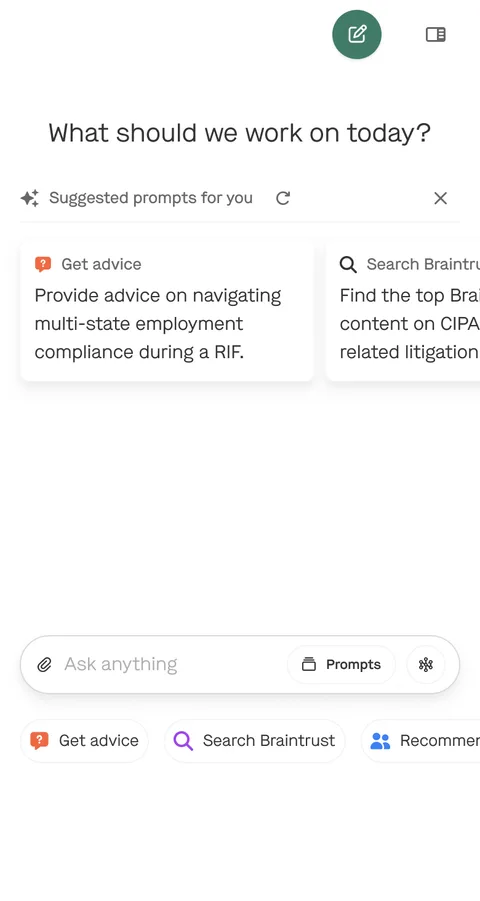
What should we work on today?
 Suggested prompts for you

 Get advice
Provide advice on navigating multi-state employment compliance during a RIF.
 Search Braintrust
Find the top Braintrust content on CIPA claims and related litigation risk.
 Recommend peers
Suggest peers with expertise in outside counsel billing and management.
 Ask anything
 Prompts
 Gpt-4o

 PromptsGpt-4o
 Get advice
 Search Braintrust
 Recommend peers
 Find the best vendor
 Find a document
Planning next move
Executive read
The current peer signal is less about rewriting a generic SCC playbook and more about closing the operational gaps behind the paper: incomplete data-flow inventories, unclear AI retention, weak onward-transfer controls, and safeguards that exist only as vendor dashboard settings. For a B2C community platform like The Suite, the practical priority is a transfer register that links each EEA data flow to its mechanism, destination, subprocessors, technical controls, and evidence owner—not another standalone transfer memo.
1. Transfer mapping is moving from vendor-level to workflow-level
Peers are trying to document not merely which vendor receives EEA data, but where prompts, outputs, backups, logs, and generated content are stored and retained across tools. One current request asks consultants to map “where are the queries saved, where is the resulting content saved,” while another seeks a ROPA template and intake questionnaire. The takeaway is to make the ROPA—or a linked transfer register—the intake layer for safeguards analysis: data category, data subjects, originating entity, importer, hosting and support locations, onward recipients, retention, access paths, and transfer mechanism.
Where peers appear to be landing: map the actual architecture before assessing safeguards. “EEA data hosted in the EU” is not enough if support personnel, model providers, telemetry systems, or backup environments can access it elsewhere. For The Suite, this should cover member profiles, direct messages, behavioral analytics, moderation data, support tickets, and AI-assisted community features separately because their sensitivity and access paths differ.
2. Onward transfers and AI subprocessors are the biggest safeguard gap
The strongest recent peer discussion centered on the mismatch between the contracting vendor and the infrastructure or model providers that actually receive data. As one participant put it, “At the end of the day, it’s a sub-processor, so if they do something wrong, it falls on the vendor.” The group nevertheless wanted express flow-down of use restrictions, segregation requirements, retention limits, and protections for future changes in model providers—not simply a generic promise that subprocessors will receive “equivalent” terms.
Where peers landed: a “no training” clause alone does not close the gap. Playbooks should test separately for runtime processing, fine-tuning, RAG, evaluations, feedback, telemetry, support access, security review, de-identification, and persistent model artifacts. They should also require notice of new subprocessors and model providers, enough information to reassess the transfer, and a practical objection or exit route.
3. Dashboard controls are evidence, not the safeguard itself
Peers reported vendors directing customers to enable data residency, zero-retention, or no-product-improvement settings in an admin console rather than accepting written commitments. The prevailing position was that these settings can be operationally useful, but are weaker than contractual protections—particularly for sensitive or regulated data—because configurations can change, administrators can make mistakes, and the vendor may modify product defaults.
A practical transfer playbook should therefore require an evidence pack for configurable safeguards: dated screenshots or exports, the setting owner, the affected workspace, confirmation that the setting covers subprocessors, and a recurring revalidation date. For higher-risk EEA flows, the contract should also state the relevant commitment and prohibit the vendor from materially weakening it without notice and an effective termination or migration right.
4. Safeguard exceptions are becoming risk-tiered, not binary
Peers favored a green/yellow/red matrix tied to both the data and the use case. Public, synthetic, or low-risk aggregated information may support lighter controls; source code, employee data, health information, financial details, customer payloads, and similarly sensitive content warrant stricter treatment. When safeguards could not be verified, the practical responses were to narrow the statement of work, exclude sensitive fields, disable the AI feature, or select another vendor—not to accept a vague de-identification promise.
For The Suite, a workable escalation rule would be: red for private messages, sensitive-profile information, minors’ data if applicable, trust-and-safety reports, or large-scale behavioral data; yellow for identifiable member and employee information with bounded access; and green for public community content or genuinely synthetic test data. Red flows should require completed mechanism and safeguards review, security sign-off, documented onward-transfer controls, and an identified exit option before launch.
5. The useful playbook artifact is a gap register with owners
The community has not surfaced a single consensus EEA transfer template this week; the signal instead points toward a compact operating system combining the ROPA, vendor review, DPA controls, retention mapping, and exception management. Teams asking for GDPR help are specifically seeking practical, targeted guidance rather than a “boil-the-ocean” global program.
The most useful gap register would contain: flow; exporter/importer; destination; mechanism; transfer assessment status; subprocessors; supplementary controls; configuration evidence; residual gap; interim restriction; remediation owner; deadline; and re-review trigger. Re-review triggers should include a new subprocessor or model provider, a hosting-location change, introduction of remote support access, new data categories, an AI feature launch, or movement from pilot to production.
For your product team, I’d turn this into a one-page EEA data-transfer design checklist for new features, with a separate exception form for unresolved safeguards. I can also draft the underlying gap register and vendor-review questions for Legal, Product, Security, and Engineering to use together.


 Ask follow-up
 Gpt-4o
Your chats are confidential. Learn more about Lloyd and our data privacy & security practices.